Raricapital
 yield aggregation: Earn APY and fees
Rari Capital’s Earn pools allocated crypto deposits across DeFi yield strategies. Their historical returns depended on strategy earnings, applicable fees and the rebalancing that took place. The SEC later challenged claims that this allocation was fully autonomous.
UpdatedYield sources and allocation
- Yield Aggregator
- Rari Capital managed Earn pools and sought higher-yield opportunities by reallocating their assets. The aggregator selected where funds were deployed; the underlying strategies generated the earnings.
- DAI pool
- Rari Capital’s December 28, 2020 Saffron partnership announcement described the DAI pool lending across multiple protocols. The same announcement named Compound Finance, Aave, yEarn and mStable among protocols then used in Rari Capital’s yield strategies.
- Fuse liquidity
- Rari Capital’s documentation also described Yield Aggregator funds supplying Fuse pools, where borrowers’ interest funded returns for depositors in the same pool. This was a historical allocation route: Rari Capital Infrastructure halted new Fuse deposits and wound down its Fuse operation in 2022 following an exploit, according to the SEC’s September 18, 2024 order.
Rebalancing and manual input
Rari Capital promoted Earn as automatically moving assets into the highest-yield opportunities available. The SEC’s September 18, 2024 enforcement announcement alleged that rebalancing frequently needed manual input and that Rari Capital sometimes failed to trigger it. A strategy’s quoted yield therefore couldn’t establish that an Earn pool had actually moved funds into that strategy.
APY, fees and realized returns
- Advertised APY
- The SEC alleged that Earn’s promoted annual percentage yields omitted various fees and that a substantial share of Earn investors incurred losses.
- Net return
- The investor’s gain or loss over the actual holding period after applicable fees. An advertised annual percentage yield (APY) doesn’t establish that result.
- Fuse performance fee
- The SEC’s September 18, 2024 order against Rari Capital Infrastructure described a historical performance fee of approximately 10% of the interest earned in each Fuse pool. Its base was pool interest, not deposited principal. That Fuse percentage doesn’t establish the fee that an Earn pool charged.
An Earn return calculation needs the applicable Earn pool’s fee terms and the relevant period.
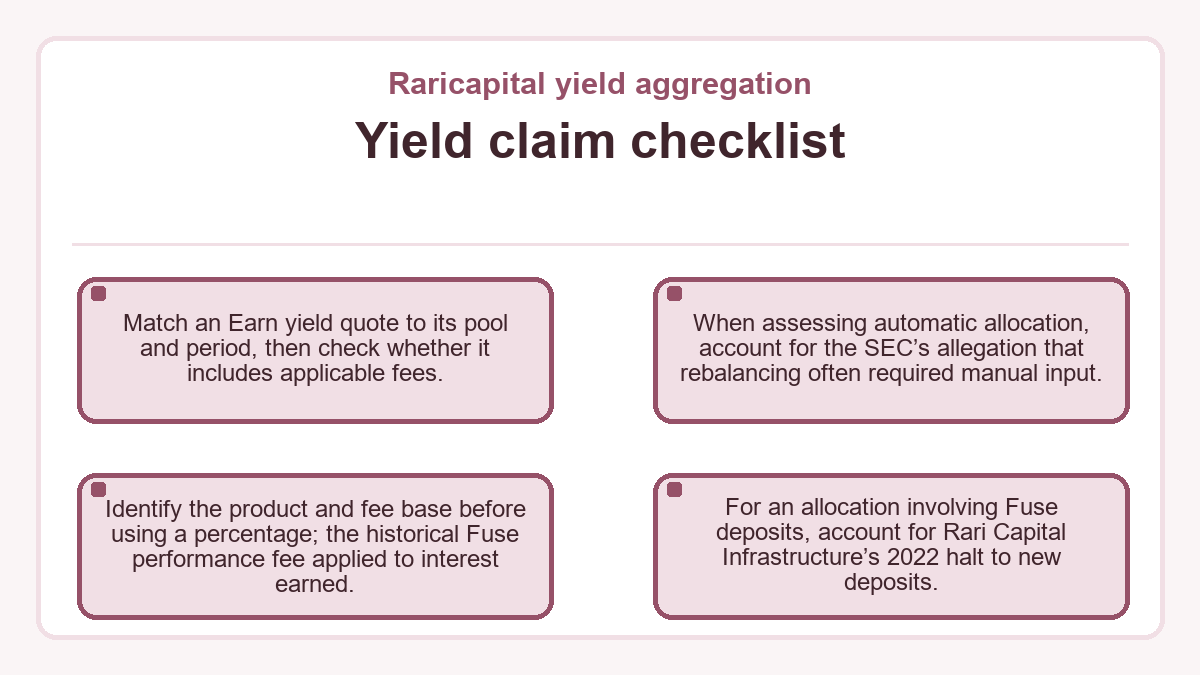
Yield claim checklist
- Match an Earn yield quote to its pool and period, then check whether it includes applicable fees.
- When assessing automatic allocation, account for the SEC’s allegation that rebalancing often required manual input.
- Identify the product and fee base before using a percentage; the historical Fuse performance fee applied to interest earned.
- For an allocation involving Fuse deposits, account for Rari Capital Infrastructure’s 2022 halt to new deposits.